what time is mars going to be visible tonight
The brightest planets in Apr's nighttime sky: how and when to see them
Have a expect into the April night skies to meet the brightest planets in the night sky. Three, and and so by April'south 2d week, four planets will exist bachelor for early risers who are up past or soon afterwards the break of dawn. They volition be all amassed low in the east-southeast part of the heaven.
Venus is by far the brightest, merely in close proximity though merely about a hundredth as bright are Mars and Saturn. Jupiter, 2d in brightness to Venus, begins to make itself evident during the second calendar week of this month and volition spend the rest of April slowly creeping closer to Venus. They will make for an centre-catching pair depression in the due east-southeast sky at month's end. And along the way, the moon will pass all four planets: Saturn on April 25, Mars on April 26 and Venus and Jupiter on April 27.
Meanwhile, holding court in the evening sky all by itself, shines Mercury during the 2d half of Apr, low in the due west-northwest about a half-hr after sundown; its best evening apparition for this year.
In our schedule, call back that when measuring the angular separation between 2 celestial objects, your clenched fist held at arm'due south length measures roughly 10-degrees. Here, we nowadays a schedule below which provides some of the best planet viewing times as well directing you lot as to where to wait to come across them.
Related: Night sky for April 2022
Mercury
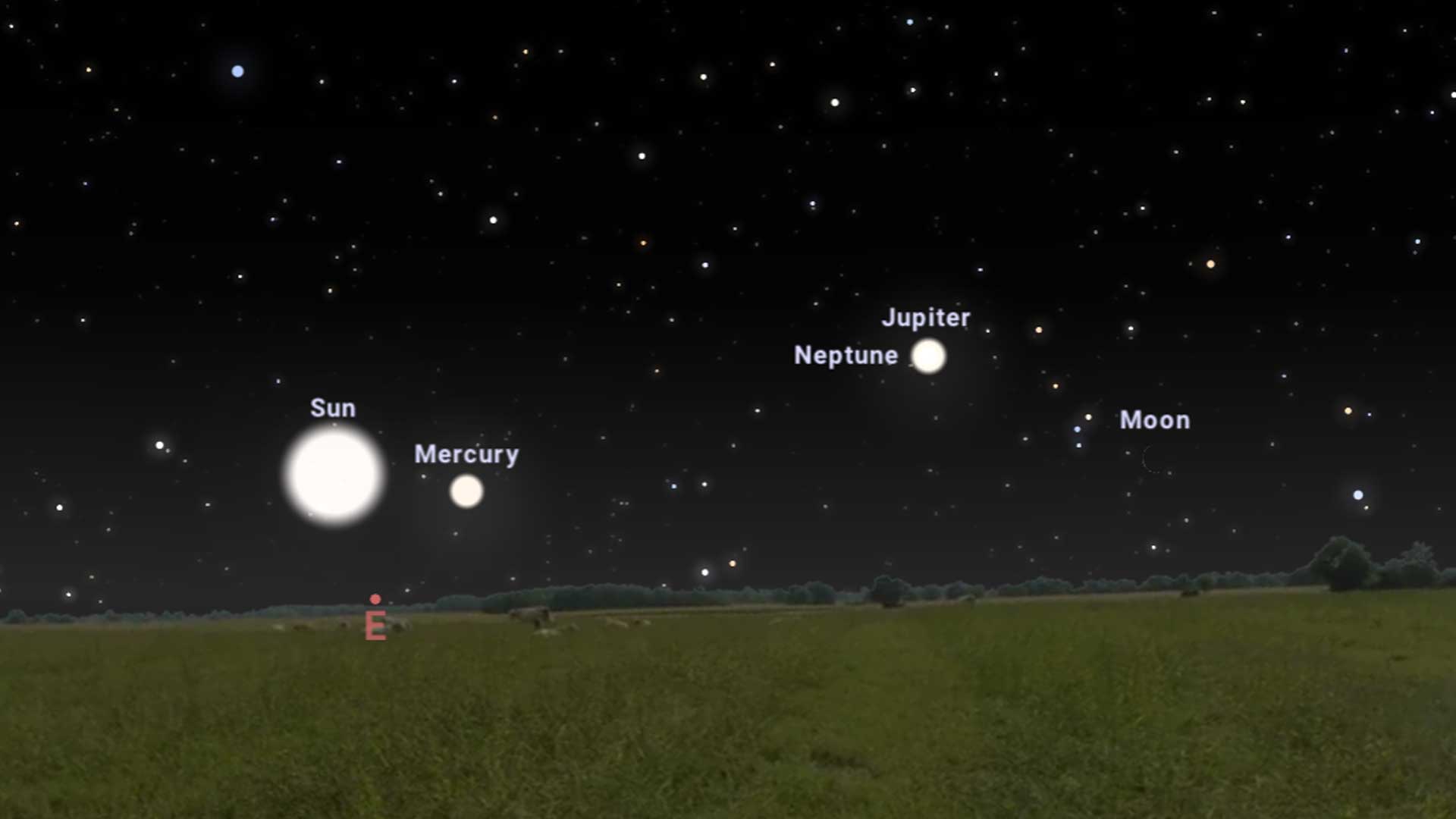
Mercury reaches superior conjunction on the far side of the sun on Apr 2, simply then vaults into dusk visibility during mid-April. Skywatchers around latitude 40 degrees due north who expect 30 minutes after dusk will discover Mercury shining at least 10 degrees in a higher place the w-northwest horizon from April 18 to May six.
Although Mercury fades 0.one magnitude per mean solar day, during the latter half of the month, the planet volition present mid-northern observers with its all-time bogeyman of the year. On April 29, Mercury reaches its greatest elongation, 21 degrees east of the lord's day; as twilight deepens, use binoculars to see the Pleiades ane.5 degrees to the upper right of the planet. On the evening of May 6, Mercury will exist within 10 degrees of the orange star Aldebaran, though the planet volition take faded to magnitude +one.6.
Venus
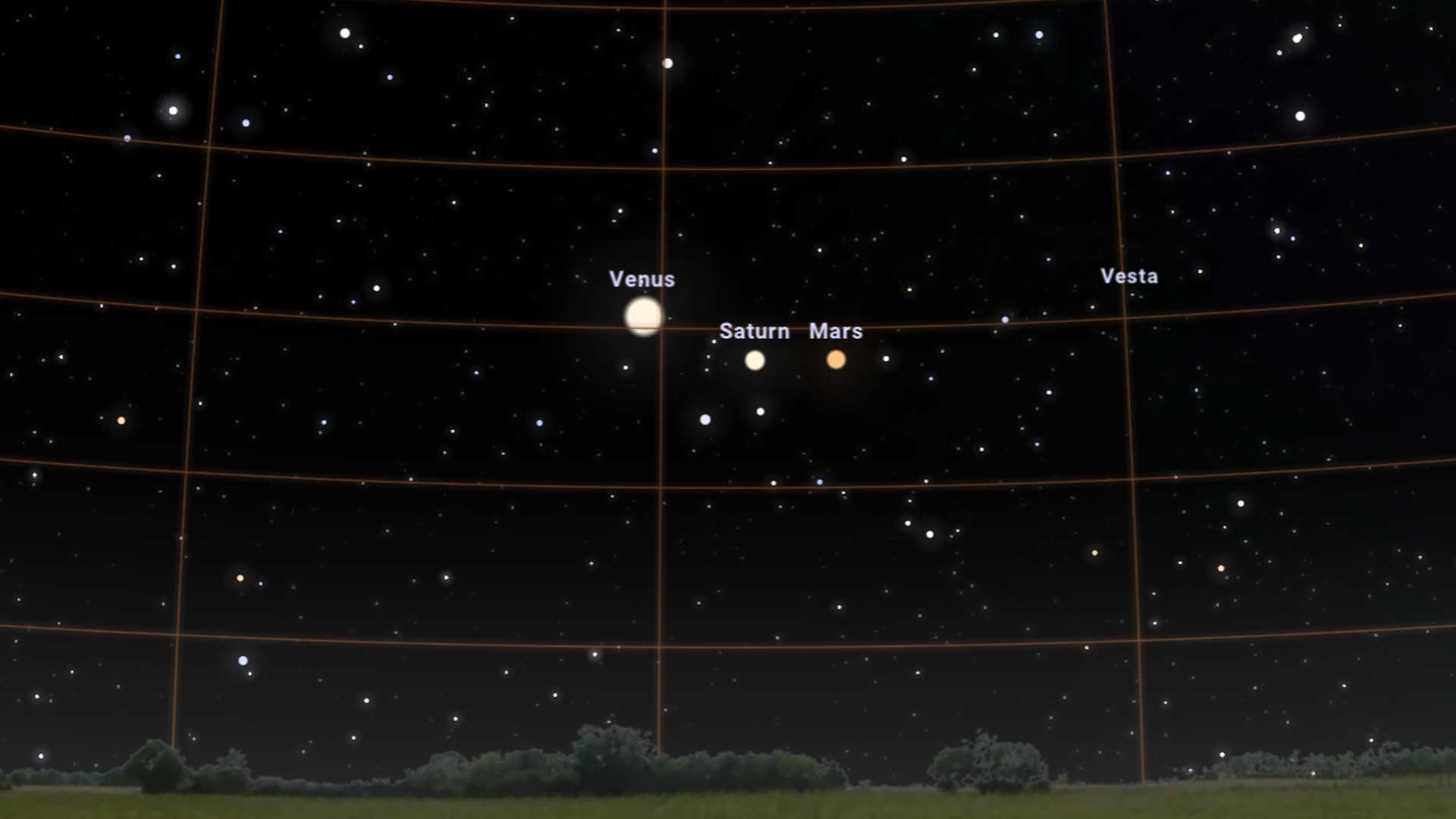
Just past its greatest elongation from the lord's day (March 20) Venus is by far the brightest and easiest planet to see in April's dawn twilight. Yet, information technology'southward less than 20 degrees high at sunrise for observers effectually latitude 40 degrees northward during this month, and its blaze dims a little during April as its earth shrinks as it recedes from Globe.
On April 1, early risers, about 75 minutes before sunrise can await very low near the east-southeast horizon for a cluster of not one, but 3 planets this morning. Along with Venus, the other two planets, off to its right are much dimmer: Saturn 4 degrees away and Mars, ii degrees to Saturn's right. You may need binoculars to see them well. Afterward in the calendar month, Venus teams with Jupiter to make for an eye-catching pair; a crescent moon will join them on Apr 27. See Jupiter below.
Mars
Mars is still no college than it was during all of Jan, February and March. It brightens slightly in April from magnitude +1.ane to +0.9, but it still doesn't look like much in a telescope, appearing equally little more than a tiny xanthous-orangish dot.
Mars is speeding eastward against the background stars. Information technology moves from Capricornus into Aquarius on April 12 and as the World gradually catches up to it in our faster orbit around the sun, we will see it enter Pisces in tardily May, and cross Aries from early July into early August. Mars volition spend the rest of the year — its months of glory when nearest the Earth — shining in Taurus high in the late-evening heaven.
It will linger betwixt the horns of Taurus from mid-September through mid-December while swelling in apparent size to a maximum of 17.2 arc seconds in early on December — its best showing until 2033. Mars will have a very close encounter with Saturn on April five. Encounter Saturn below. Early on the forenoon of Apr 26, the moon will laissez passer Mars. Both objects are visible low in the due east-southeast in the early on dawn, with Mars positioned about 6.v degrees to the moon's upper right.
Jupiter
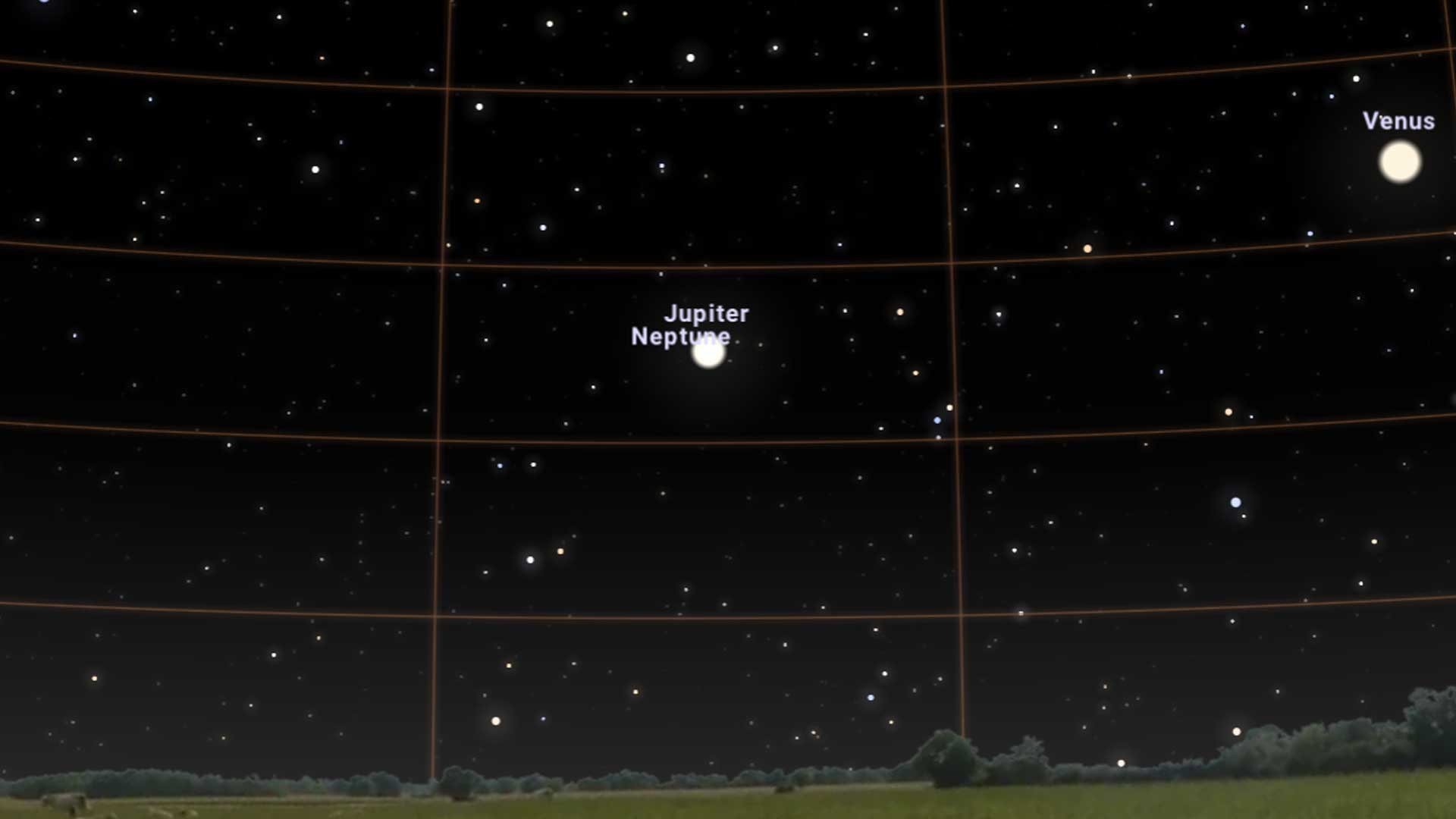
Subsequently spending the by month obscured past the bright glare of the sun, Jupiter finally begins emerging dorsum into view during the second week of Apr. On the morning of April eight, about a one-half an hour earlier sunrise, wait low near the eastern horizon for the bright low-cal of this large planet, situated nigh 20 degrees to the lower left of Venus.
Over the next three weeks, watch as Jupiter steadily climbs toward Venus and slowly and dramatically closes the gap between them by roughly one degree per day. On the morning time of April 27, it will be likely that radio stations and early morn TV news shows will be getting telephone calls inquiring equally to what those ii 'very bright stars' are, hovering above the slender crescent moon.
Merely 'in-the-know' Infinite.com followers volition already know that they're non UFOs but Jupiter and Venus. They are in conjunction on April xxx, making for a spectacular sight in the east-southeast sky only earlier sunrise.
Saturn
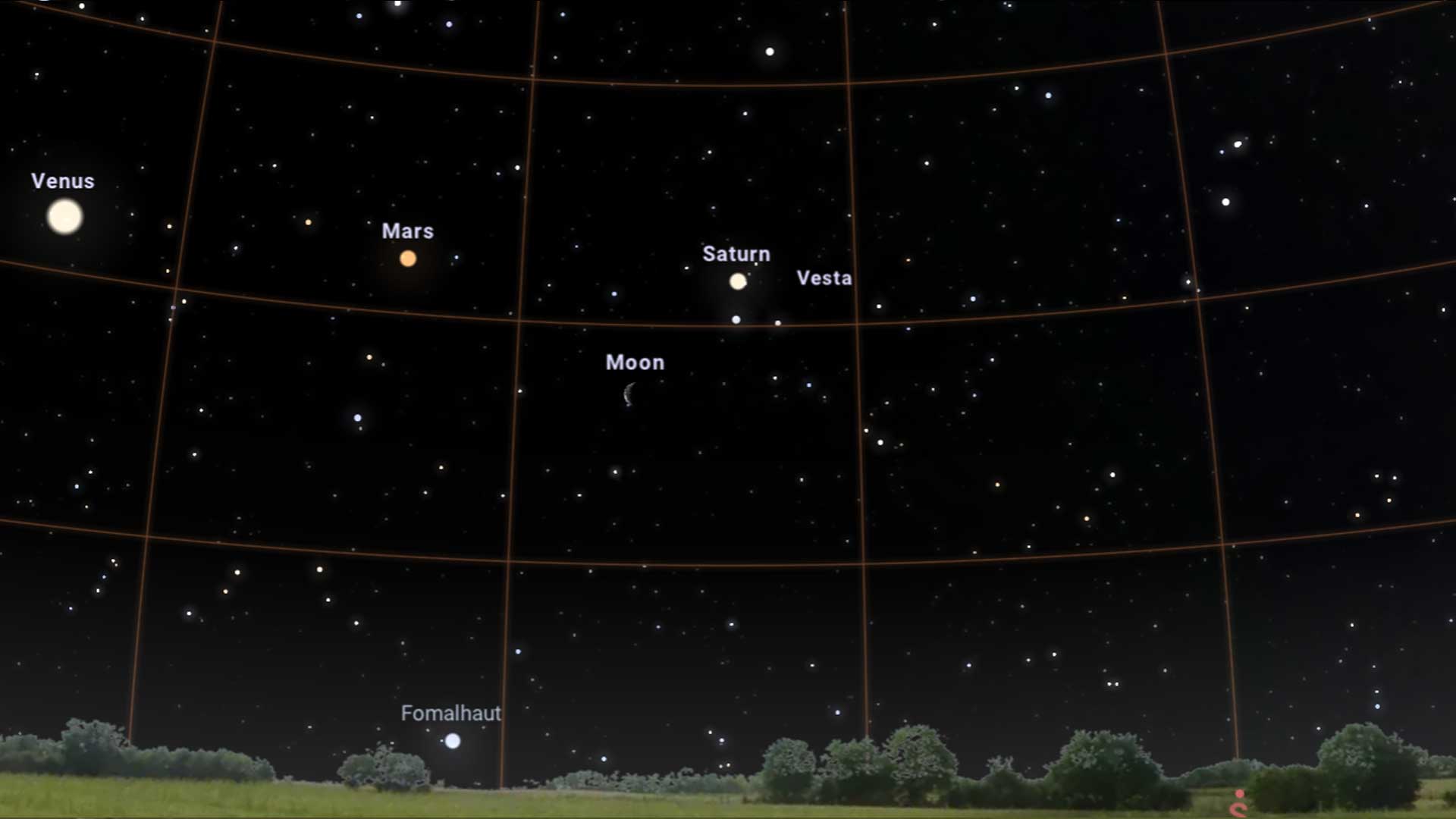
Saturn will engage with Mars on April v. The Red Planet overtakes Saturn early on this morning with the two planets engaged in rather tight conjunction. The two planets are separated by less than 0.4 degrees, with Saturn shining above and at magnitude +0.9, appearing to shine a trifle brighter than Mars (+1.0).
Binoculars will bring out the orangish-yellowish color of Mars contrasting with the yellow-white glow of Saturn. On the forenoon of April 25, look for a ringed planet hovering like a bright xanthous-white 'star' about 8 degrees to the upper right of the fat, waning crescent moon.
Joe Rao serves as an instructor and guest lecturer at New York's Hayden Planetarium (opens in new tab) . He writes about astronomy for Natural History magazine (opens in new tab) , the Farmers' Annual (opens in new tab) and other publications. Follow us on Twitter @Spacedotcom (opens in new tab) and on Facebook (opens in new tab) .
Bring together our Space Forums to continue talking infinite on the latest missions, night heaven and more than! And if y'all take a news tip, correction or comment, allow us know at: customs@space.com.

Joe Rao is Space.com's skywatching columnist, also equally a veteran meteorologist and eclipse attorney who also serves as an instructor and guest lecturer at New York'south Hayden Planetarium. He writes nearly astronomy for Natural History magazine, the Farmers' Annual and other publications. Joe is an 8-time Emmy-nominated meteorologist who served the Putnam Valley region of New York for over 21 years. Yous can discover him on Twitter and YouTube tracking lunar and solar eclipses, meteor showers and more than. To find out Joe's latest project, visit him on Twitter.
Source: https://www.space.com/33619-visible-planets-guide.html
0 Response to "what time is mars going to be visible tonight"
Postar um comentário